EU-GaNoM Voices | The People Behind EU-GaNoM
Beyond Project Results: The People, Experiences and Connections That Matter
What makes a European project truly meaningful?
Beyond its deliverables and achievements, it is often the people, shared experiences and professional relationships that leave the most lasting impact.
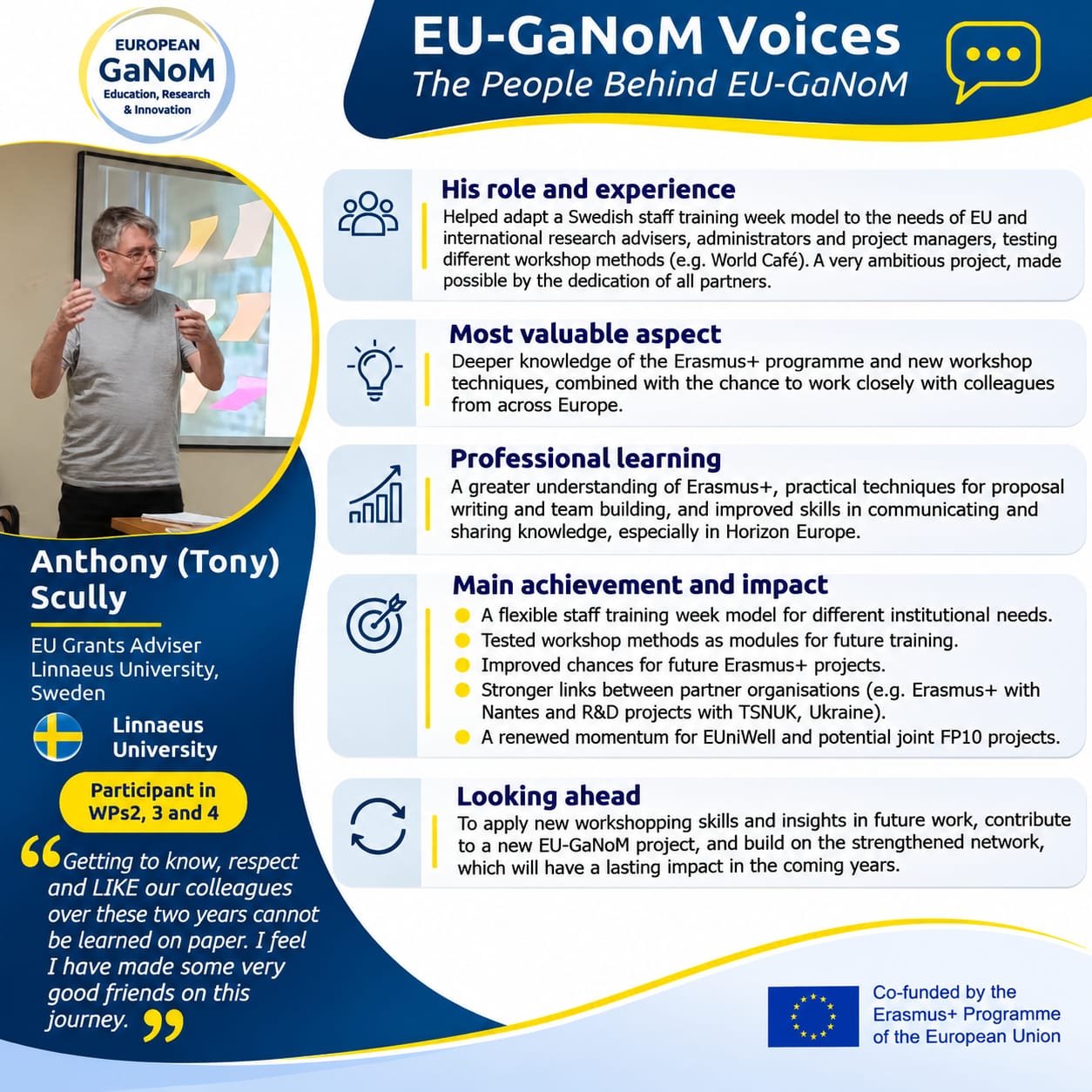
In this special written contribution to our EU-GaNoM Voices series, Anthony (Tony) Scully, EU Grants Adviser at Linnaeus University and contributor to WP2, WP3 and WP4, shares his reflections on the EU-GaNoM journey.
From innovative training methodologies and professional learning to international collaboration and lasting friendships, Tony offers a thoughtful perspective on what the project has achieved and what its legacy means for the future.
We invite you to discover his reflections in his own words.
1What has been your role in the EU-GaNoM project, and how would you describe your experience working on it?
My role in EU-GaNoM was to help in adapting an existing Swedish staff training week model to a more specific target group of professionals and academics, with clearer goals and more effective expected results, including experimenting with different workshop forms and techniques (e.g. World Café).
The previous staff training weeks in Sweden had taken the form of exchanging ideas and methods in a more general way, according to more general themes; so for EU-GaNoM, the level of commitment and effort on the part of the organisers and the invited participants would prove to have increased very substantially from that experienced in the earlier forms of staff training week.
My experience is that the project and the work involved was very ambitious, taking a model for creation and coordination of the annual international staff training week which had been conducted at Linnaeus University in Kalmar and Växjö in Sweden 14 times already, and adapting it specifically to address EU and international research advisers, administrators and project managers, and resulting in tests of many and varied forms of workshop technique.
Amazingly, in my opinion, we managed to achieve that level of ambition due to the dedication of our team of partners across Europe.
The first EU-GaNoM staff training week, in Kalmar, Sweden in June 2025, experimented with different ways in which to discuss the coordination of Erasmus+ and Horizon Europe project proposals and projects. A great deal was learned about the different ways in which we operated in our respective universities in Albania, France, Sweden, Spain and Greece; and this knowledge was worked upon further in the second staff training week in Murcia, Spain, in April of 2026, where we used the same and other techniques to deal with financial and project management.
EU-GaNoM’s weeks proved to be very intense and results-oriented, which in my opinion increased the enthusiasm and drive to learn and teach amongst the participants.
Lastly on the subject of my experiences within the project, I gained an enormous respect for our colleagues at the other institutes, and a definite wish to participate again with them on future projects.
2What has been the most valuable or rewarding aspect of your involvement in the project?
There were two technical areas in which I found the project highly rewarding: deeper knowledge of the Erasmus+ programme in particular, and knowledge of new techniques for workshopping a problem or task. And there was one qualitative area.
Although I work in Erasmus+ Cooperation Partnerships, Capacity Building projects and Alliances for Innovation, my main area of interest is in Horizon Europe, especially Pillar II (Global Challenges – multi-national, multi-discipline applied research and innovation projects to answer a real-world need).
Therefore, participating in EU-GaNoM allowed me to learn a great deal from my colleagues, particularly in Nantes but also in our workshops in both years, about their approaches to the more education-oriented Erasmus+ programmes.
Workshop techniques that were used in both years also revealed to me many new ways of interacting, also possibly with our own researchers, and of creating enthusiasm – fun – and more goal-oriented mindsets among participants.
The qualitative value that I got from EU-GaNoM was simply that: the fun. Getting to know, respect and LIKE our colleagues over these two years cannot be learned on paper. Our days online putting things together, but especially our face-to-face meetings, were so full of energy and humour. And I feel I have made some very good friends on this journey.
3What have you learned or gained professionally through your participation in EU-GaNoM?
That would again be the greater knowledge of Erasmus+ that I received, and of the various techniques that can be used for the purpose of writing proposals and setting up teams, that we gained through hands-on workshops.
But another aspect is improving my own knowledge of how to impart information, especially in my field of Horizon Europe (and I hope the next framework programme FP10), and of using the techniques we practiced in my own presentations.
4What do you consider the project's main achievement or impact for your institution?
The impacts are many, but just a few here.
- We have created a model for a staff training week that can be adapted by anyone to their own institutional needs.
- We have tested and demonstrated different workshopping methods that can be selected as modules for any future construction of a staff training week.
- We have improved our chances of future projects along the same lines through Erasmus+.
- We have cemented strong links between our own organisations for future project development – to name a few at random, E+ proposals with Nantes, and research and development projects with TSNUK in Ukraine.
- And I believe that we have given EUniWell a shot of energy with this project – a will to try anything, for example joint FP10 projects, with the partners from EU-GaNoM and other EUniWell partners who could benefit from our experienced ways of working. I personally would like to see us coordinating FP10 applied research projects together.
5What will you take forward from EU-GaNoM into your future work, and how do you see its results being sustained beyond the project's lifetime?
I will take forward new workshopping skills, new insights into project formation and development, and new techniques for meeting and training.
I believe we have a plan to produce a new EU-GaNoM project in the very near future, and I look forward to seeing how I may contribute to that new project. But besides that, I believe that all the participants like myself have enhanced our networking between each other due to this project, and that will have a lasting effect in the coming years.
