Back

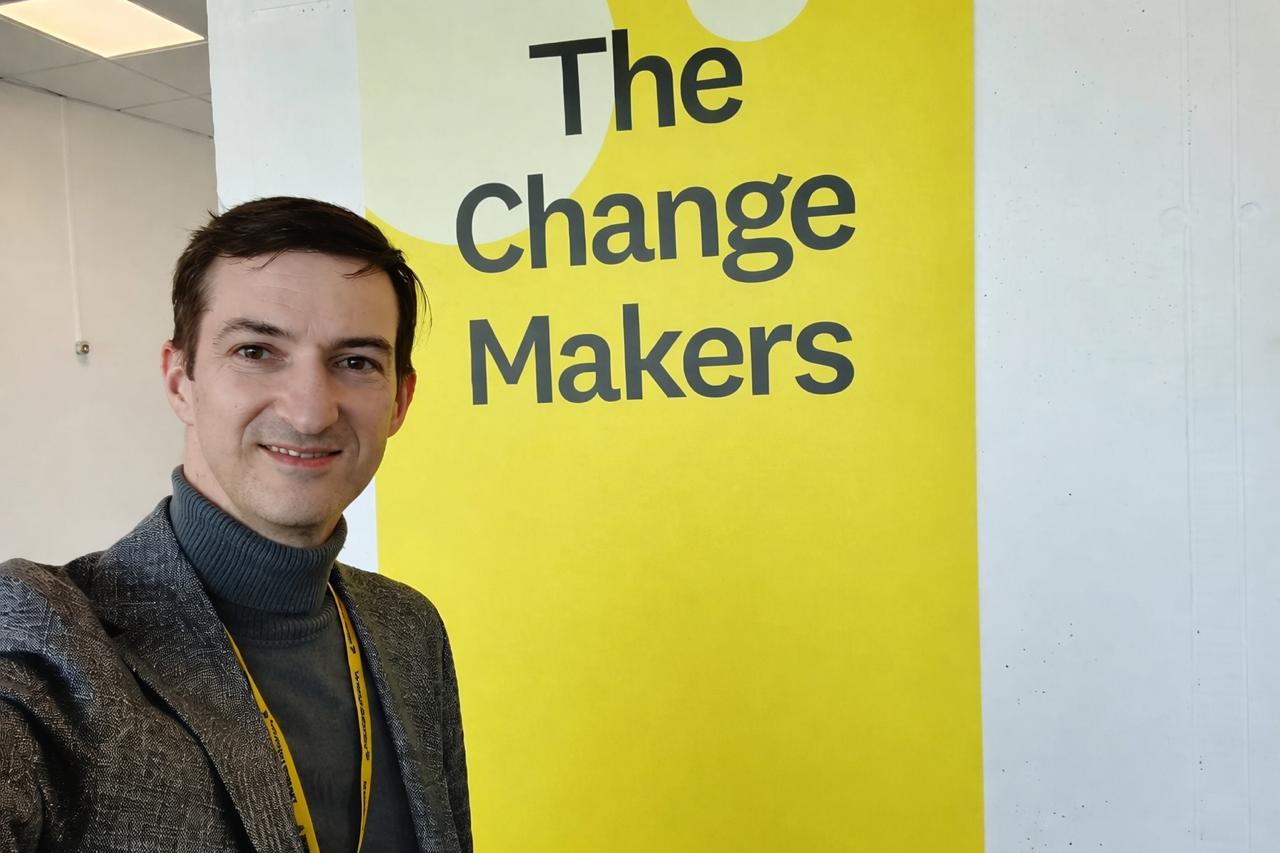
Roman Petyur: “A grant advisor is a navigator, turning an idea into a real project”

Erasmus+ Project Interview

EU-GaNoM Project: Interview with Roman Petyur

The EU-GaNoM project, funded by the Erasmus+ programme, became the first initiative at Taras Shevchenko National University of Kyiv (KNU) aimed at systematically developing university staff competencies in the field of project management.

It brought together a consortium of six universities: the University of Nantes (France), Linnaeus University (Sweden), the University of Murcia (Spain), the University of Crete (Greece), the University of Tirana (Albania), and Taras Shevchenko National University of Kyiv.

Roman Petyur, the project coordinator from KNU and the Head of the International Relations Office, shared insights on the strategic importance of this network, ways to overcome staffing shortages during wartime, and the implementation of game-based learning methods.

Roman, the EU-GaNoM project has been running for two years now. What strategic importance does it have for the internationalisation of KNU and for strengthening its position in the European space?

There are several reasons this project is significant. Firstly, it is implemented within the framework of our partnership with the EUniWell Alliance, which we joined in 2022. Two-thirds of the consortium members are universities from this Alliance. Secondly, this is a unique experience: it may be the first Erasmus+ academic project that does not focus on students or faculty, but on developing the skills of administrative staff. This underscores our strategic approach to strengthening the University’s presence in international project activities.

What are the main challenges facing Ukrainian grant advisors today, and how will the project help them overcome these challenges?

The primary challenge is that, traditionally, the development of project-based activities has not been a priority in Ukrainian higher education due to a lack of internal funding. We have always relied on external grants, but we face a shortage of personnel who are familiar with the rules of European funding programmes. Opportunities for Ukraine have increased today; however, in the context of a wartime crisis, it is critically important for us to take advantage of them – not merely to ‘preserve ourselves’, but to improve and be prepared for the recovery phase. The participation of KNU in the EU-GaNoM project is specifically aimed at overcoming this lack of expertise.

Synergy between the Erasmus+ and Horizon Europe programmes is often discussed. Why is it important to combine educational and research components within a single strategy?

In European practice, these areas are often managed by different, non-overlapping departments. However, the concept of our project is to emphasize the common features of both programmes at the management level: the project lifecycle, drawing project proposals, and financial management all follow a similar pattern. We seek to develop transversal skills in our specialists – universal skills for managing European projects. Doing so will make individuals flexible: they will be able to work equally effectively on both academic and research projects.

What key skills would you highlight as essential for a successful grant advisor?

First and foremost is the ability to identify an idea and correlate it with a specific project call. We have many talented people, but they don’t always know how to turn an idea into a project. A grant advisor is a navigator turning an idea into a real project. The second skill is practical project management, which involves understanding a project as a set of activities with a well-defined purpose, constrained by the time and resources of a specific institution.

The project involves creating interactive content. Could you please elaborate on this?

The goal of the project is to develop a methodological framework and supporting materials that the University can use independently. Each University partner is a co-author of these training materials, and they belong to the institution, not to individual people. This will allow us to scale up our experience: the project office will be able to conduct regular training sessions for faculty representatives using these resources. Although programme requirements may change, the methodology we have established will remain a stable foundation.

The project team is heading to the University of Murcia (Spain) in April, 2026. What are your expectations for this visit?

This will be a very high-level training week, whose programme has brought together the ‘cream of the crop’ of international project activity in terms of both content and speakers. In addition to the basic topics of the project lifecycle, we will delve into highly specific issues, for instance, financial management of European projects with a lump-sum grant, for which there is still little reporting experience. A unique game-based session is also planned: through gamification and simulations, participants will learn how to form consortia, assess risks, and develop project development scenarios. This will allow them to gain practical experience at an accelerated pace.

Does KNU plan to implement its own educational programmes based on the outcomes of the project?

Undoubtedly. Our priority is to create relevant certification programmes. We aim to develop a flexible framework with several modules, so each staff member can choose exactly what corresponds to their needs. This is what will ensure the project’s sustainability and provide tangible added value for the University, even after funding ends.